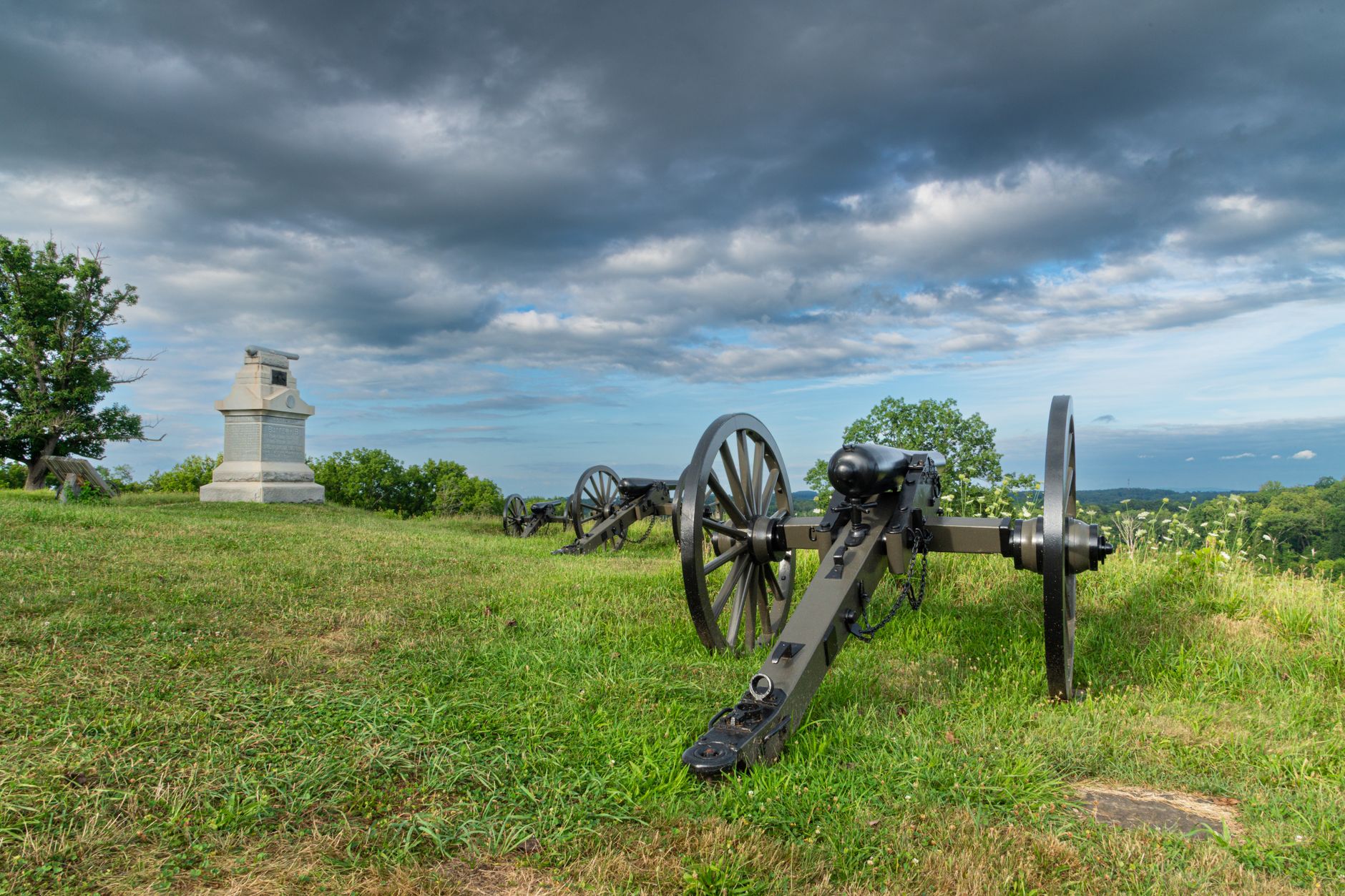
The Stage is Set: Gettysburg 1863
In the sweltering summer of 1863, the quaint town of Gettysburg, Pennsylvania, became the epicenter of the bloodiest battle ever fought on North American soil. The Union and Confederate armies clashed in three fateful days, deciding the fate of the United States forever. This article delves into the history of the Battle of Gettysburg, examining the strategic blunders, courageous heroes, and the lasting legacy of this pivotal conflict.
Background and Origins: The Road to Gettysburg
By June 1863, the Civil War had dragged on for two exhausting years. Robert E. Lee, the charismatic commander of the Army of Northern Virginia, sought a bold solution to end the stalemate. He decided to take the war north, invading Pennsylvania, hoping to move the fighting out of war-ravaged Virginia (and allowing farmers to harvest crops during the crucial summer months).
Lee had multiple strategic objectives. First, he aimed to threaten Northern cities like Harrisburg and even Philadelphia, hoping to pressure President Abraham Lincoln into negotiating a peace treaty. Finally, a decisive victory on Northern soil could potentially encourage foreign powers like Britain or France to recognize the Confederacy.
On June 3, 1863, Lee's army began marching north. The Union Army of the Potomac, initially under General Joseph Hooker and later under General George G. Meade, pursued them cautiously. The collision course was set not by grand strategy, but by chance. Confederate troops moved toward Gettysburg because they heard there was a supply of shoes in the town. On June 30, Union cavalry spotted Confederate infantry approaching west of town. The stage was set for a catastrophic encounter neither side had fully planned for.
Key Events: The Three Days of Battle
The fighting began on July 1, 1863, when Confederate General Henry Heth's division encountered Union General John Buford's cavalry dismounted on McPherson Ridge. The Union forces held tenaciously until reinforcements arrived, but they were eventually outnumbered and forced to retreat through the streets of Gettysburg. They took defensive positions on high ground south of town—Cemetery Hill, Cemetery Ridge, and Culp's Hill. General Lee understood the importance of this high ground but lacked the intelligence to know exactly how many Union troops he faced. He ordered General Ewell to take the hills "if practicable," a discretionary order that Ewell chose not to execute, a decision that would cost the Confederacy dearly.
The second day, July 2, was the largest and costliest of the battle. Lee launched a massive assault against the Union flanks. On the left, General James Longstreet's corps attacked the Round Tops and the Wheatfield. In one of the battle's most famous moments, Colonel Joshua Chamberlain and the 20th Maine Regiment defended the extreme left flank at Little Round Top. Running low on ammunition, Chamberlain ordered a desperate bayonet charge that routed the attacking Confederates and saved the Union line. Meanwhile, fierce fighting raged at the Peach Orchard, the Devil's Den, and Culp's Hill. Despite heavy casualties and several close calls, the Union "fishhook" defensive line held firm by nightfall.
July 3 marked the climax of the battle. Lee, convinced the Union army was battered and low on morale, ordered a frontal assault against the center of the Union line on Cemetery Ridge. At 1:00 PM, nearly 150 Confederate cannons opened fire in the largest artillery bombardment of the war, intending to soften the Union defenses. However, most of the shells overshot their targets. When the fire ceased, roughly 12,000 Confederate infantrymen stepped out of the woods and began the long march across open fields toward Cemetery Ridge. This became known as Pickett's Charge. As they crossed the nearly mile-wide expanse, Union artillery exploded amidst them, and infantry fire ripped through their ranks. Only a few hundred Confederates reached the stone wall, where they were immediately captured or killed. Lee watched his army retreat in horror, famously telling them, "It is all my fault."
Surprising Facts Most People Don't Know
While most history books focus on the generals, the human element of Gettysburg is filled with bizarre and heartbreaking details. One of the most shocking facts is the role of civilians. The battle was fought in and around a town of 2,400 people. Residents like John Burns, a 70-year-old veteran of the War of 1812, grabbed his musket and fought alongside Union soldiers. The only civilian casualty during the battle was Mary Virginia "Jenny" Wade, a 20-year-old who was baking bread in her kitchen when a stray bullet struck her, killing her instantly.
Another common misconception involves the "shoes." While history books often say the battle started because Confederates were looking for shoes in Gettysburg, historians agree this was likely a post-battle myth. A.P. Hill's corps was moving toward Gettysburg to screen Lee's army, not to raid stores. Furthermore, the aftermath created a gruesome medical crisis. The sheer number of amputations required led to the creation of "limb pits," where surgeons disposed of severed arms and legs. Photographer Alexander Gardner arrived days later to capture images of these piles, bringing the horrific reality of war to the American public for the first time.
Finally, the geography of the battlefield shifted permanently. After the battle, a massive collection of discarded rifles was gathered. Many were found to be double-loaded, indicating that in the heat and smoke of battle, soldiers often forgot they had already loaded a round and jammed another on top of it, rendering their weapons useless.
Impact and Legacy: Why It Was the Turning Point
The Battle of Gettysburg ended Robert E. Lee's second and final invasion of the North. The casualty numbers were staggering: approximately 51,000 soldiers were killed, wounded, captured, or missing, making it the bloodiest battle of the Civil War. The Army of Northern Virginia suffered 28,000 casualties—over one-third of its strength—from which it never fully recovered. Lee's army retreated back across the Potomac River into Virginia, remaining on the strategic defensive for the rest of the war.
Politically, the victory was a lifeline for the Lincoln administration. Until Gettysburg, the North had grown increasingly war-weary, and peace factions known as "Copperheads" were gaining traction. The defeat of Lee's army bolstered Northern morale and silenced many critics of the war effort. Crucially, the victory coincided with the fall of Vicksburg on July 4, 1863, which gave the Union control of the Mississippi River. These two victories marked the psychological shift where the realization of Union victory became probable.
Perhaps the most enduring legacy came four months later. On November 19, 1863, President Lincoln dedicated the Soldiers' National Cemetery in Gettysburg. His Gettysburg Address, a mere 272 words, redefined the purpose of the war. It shifted the focus from preserving the Union to the broader principle of human equality and "a new birth of freedom." It transformed Gettysburg from a place of slaughter into a symbol of national rebirth.
Why This Still Matters Today
The Battle of Gettysburg remains vividly relevant in the American consciousness because it represents the ultimate test of the democratic experiment. It was the moment when the question of whether a nation "conceived in liberty and dedicated to the proposition that all men are created equal" could long endure was answered violently in the affirmative.
Today, Gettysurg serves as a reminder of the cost of division. The battlefield is one of the best-preserved military parks in the world, attracting visitors from across the globe. The debates over states' rights versus federal authority that sparked the war continue to influence modern American political discourse. Understanding the tactical decisions and the immense sacrifice at Gettysburg helps us contextualize the ongoing struggle to define American identity and the meaning of freedom.
Quick Facts
- Date: July 1–3, 1863
- Location: Gettysburg, Pennsylvania
- Total Casualties: Approximately 51,000 (23,000 Union, 28,000 Confederate)
- Commanders: General George G. Meade (Union), General Robert E. Lee (Confederate)
- Key Engagement: Pickett's Charge involved roughly 12,000 Confederate infantrymen
- Aftermath: The battle site is now the Gettysburg National Military Park
Reflections on a Nation's Destiny
The Battle of Gettysburg was more than just a military engagement; it was the hinge upon which the fate of the United States turned. By halting Lee's invasion and inflicting irreparable damage on the Confederate army, the Union forces paved the way for ultimate victory. The battle taught us that high ground, leadership, and resilience are decisive factors in history, but it also showed the terrible price of civil conflict. As we look back on the smoke and fire of those three days, we must ask ourselves: How have the ideals fought for at Gettysburg shaped the America we live in today?