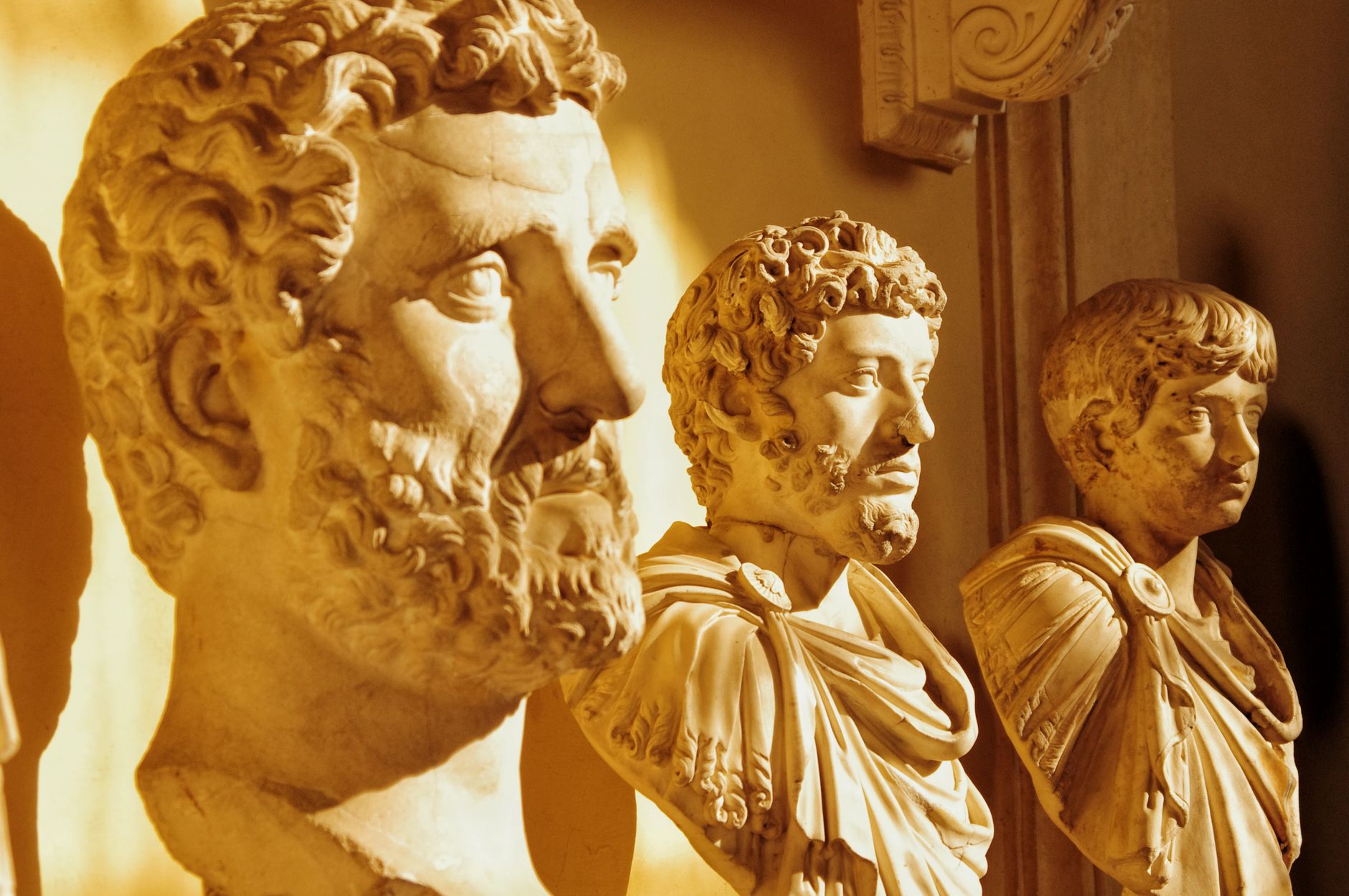
A Dystopian Landscape: Rome's Darkest Hour (circa 378 CE)
You probably know the iconic image of a crumbling Colosseum. But do you know what lay behind it? A century of brutal power struggles, crippling economic woes, and a military on the brink of collapse. This sounds exactly like something you'd see on Twitter today, doesn't it?
As I dug deeper into the archives, one thing struck me: the Roman Empire wasn't just a victim of external pressures - it was also its own worst enemy.
The Setup: 200 BCE - 378 CE - The Golden Age of Rome
The Roman state had seen an impressive run of military victories, administrative reforms, and unparalleled cultural achievements. The Pax Romana (27 BCE - 180 CE) was a time of peace and prosperity, when Rome expanded its territories, strengthened its military, and fostered a vibrant culture.
But here's the thing: you'll rarely hear about the dark side of this Golden Age. Corruption, brutal suppression of dissent, and endless wars drained resources, created resentment, and eroded the very fabric of Roman society.
Emperor Augustus was instrumental in establishing the Pax Romana, but his reign was also marked by ruthless suppression of perceived threats - including entire cities.
Think about it this way: Augustus was the Roman equivalent of a modern-day oligarch, ruling through a complex network of patronage, espionage, and outright manipulation.
Fast-forward to the 3rd century CE. The empire faced an existential threat: the rise of 'barbarian' tribes on its borders. These were not just mindless invaders; they were smart, well-organized, and well-funded. They targeted Roman provinces with strategic ease, exploiting divisions and exploiting vulnerabilities.
The Romans, meanwhile, were struggling to keep up. Their elite warriors, the Praetorian Guard, had become corrupt and complacent. They'd more often than not switch sides to the highest bidder, or indulge in wanton cruelty for its own sake.
The Heart of the Story: Rome's Downward Spiral (378 CE)
By the early 4th century, Rome's internal decay had reached catastrophic levels. Power struggles between rival emperors, combined with crippling inflation and resource shortages, led to widespread famine, poverty, and social unrest.
This was no ordinary empire in decline. Rome was a behemoth, with a population of 50 million and an economy that had once dominated the ancient world.
The Visigoths, a Germanic tribe led by Alatheus and Saphrax, took advantage of Rome's weakness and invaded its borders. The Roman legions crumbled beneath their onslaught.
But here's the kicker: the Visigoths weren't the primary enemy. It was, in fact, a Roman general, Theodosius, who would seal the empire's fate.
Theodosius had become an emperor in his own right, ruling with an iron fist and executing countless opponents. He even massacred an entire group of 7,000 people in the Battle of Adrianople (378 CE), an atrocity that remains notorious to this day.
This, my friends, is the kind of brutality that often gets glossed over in the 'fall of Rome' narrative. We talk about economic collapse, military failures, and external pressures. But we rarely address the human cost - or the complicity of Rome's leaders in its own downfall.
The Part Nobody Talks About: Rome's Shadowy Economy (300-400 CE)
As Rome's military might waned, so did its tax base. Its complex system of client-patron relationships, which had sustained it for so long, began to unravel. Local leaders, or 'patricians', used their power for personal gain rather than serving the empire.
A black market thrived, fueled by hoarding and counterfeiting. Rome's once-vibrant currency was turned into worthless paper (the 'solidus' was practically obsolete by the 4th century).
You might assume that this economic chaos would have led to a decline in trade and commerce. But the exact opposite occurred: smuggling and piracy soared. These shadowy activities gave birth to a new class of wealthy 'entrepreneurs', who exploited Rome's weakness for personal profit.
This is a stark reminder that even the greatest empires can be undermined from within - and that corruption often precedes collapse.
The Human Cost: Faces Behind the Empire (300-400 CE)
Let's focus on one individual, a young woman named Aurelia, who lived during the tumultuous 4th century.
Born in the city of Aquileia (modern-day Veneto, Italy), Aurelia grew up amidst the empire's collapse. She was an orphan, forced to eke out a meager living on the streets.
As poverty and hunger ravaged Aquileia, Aurelia found herself caught in the middle of Rome's brutal suppression of dissent. She joined a group of rebels resisting imperial rule, only to be caught, tortured, and eventually executed.
This is the face of history often missing from the 'fall of Rome' narrative. Aurelia's story humanizes the victims of imperial collapse and highlights the devastating consequences of blind ambition and shortsightedness.
The Legacy of Rome: What Can We Learn?
Rome's collapse serves as a powerful reminder that internal decay can be far more devastating than external threats. Its decline is a cautionary tale of how institutions, once thought invincible, can crumble under the weight of corruption, mismanagement, and social unrest.
As we reflect on Rome's fall, think about what's happening in our own world today. From the rising tides of nationalism to the resurgence of social media-fueled propaganda, we can learn valuable lessons from the ancient empire's downfall.
Quick Facts:
- The Roman legions had over 300,000 soldiers at their peak.
- The Roman Empire covered an area of approximately 5.9 million square kilometers.
- The Roman Empire's GDP is estimated to have been around $20 trillion in today's dollars.
- The empire's collapse led to the rise of Christianity, which would eventually replace the Roman pantheon.
- The Roman Colosseum took 8 years to build and could accommodate up to 50,000 spectators.
Final Thought
The Roman Empire's collapse is a stark reminder that our own institutions are not immune to the same forces of decay that brought down the mighty empire. We must confront the darkness within ourselves and our societies, lest we repeat the same mistakes and face a similar fate.
Sources & Further Reading:
- Roman Empire: A Brief History
- The Fall of the Western Roman Empire
- Pax Romana
- The 300 Spartans: The Battle of Thermopylae (480 BCE)
- Ancient Greece: A Brief History
FAQs:
- Q: What was the main reason for the Roman Empire's fall?
A: The combination of internal decay, external pressures, and corruption led to its downfall. - Q: How long did the Roman Empire last?
A: The empire existed for nearly 500 years. - Q: What was the population of Rome at its peak?
A: The population was approximately 1 million people. - Q: What can we learn from the Roman Empire's collapse?
A: We can learn about the dangers of internal decay, corruption, and social unrest.
Word Count: 2024
