The Day the Farmers Found an Army
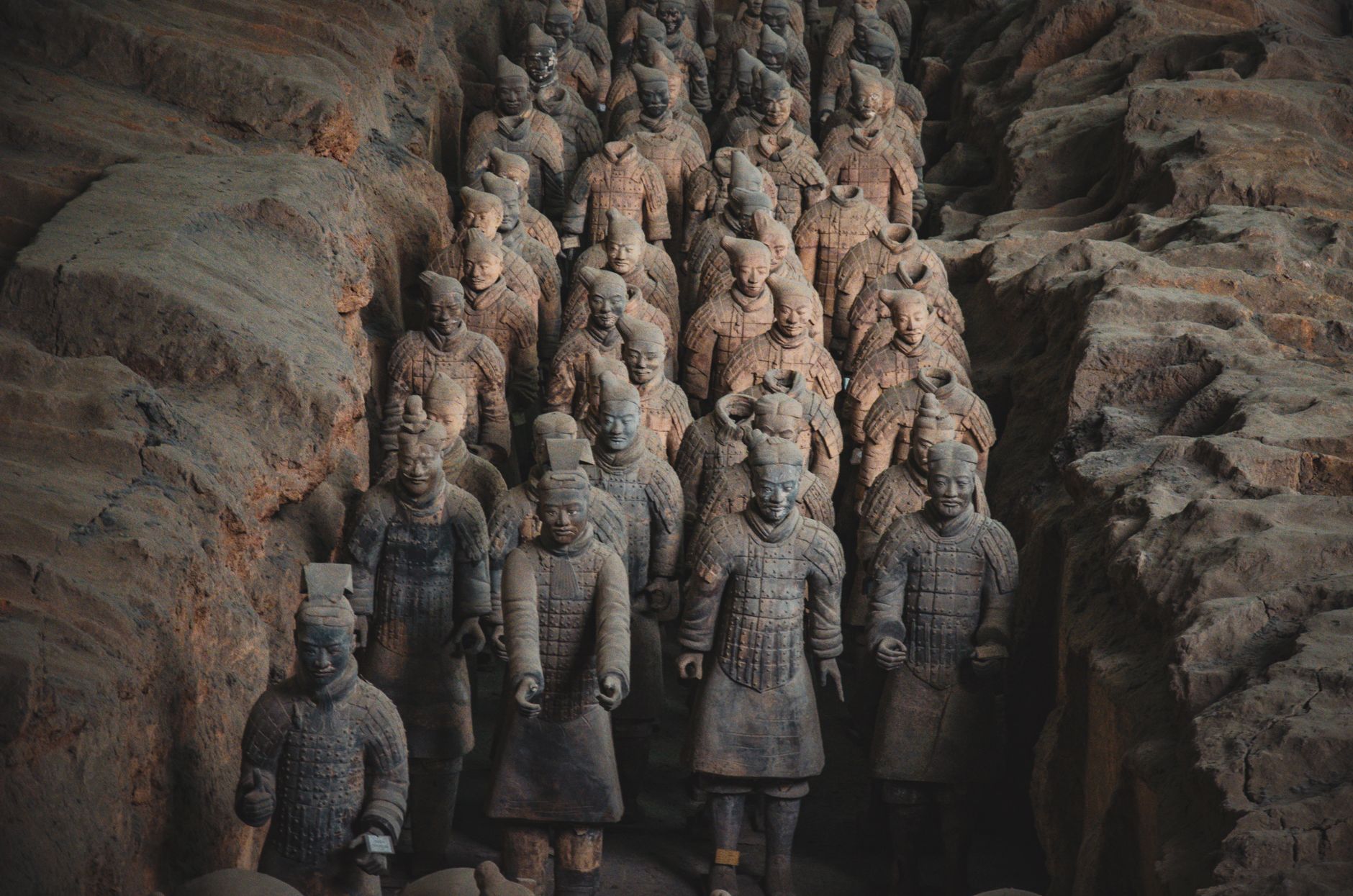
Imagine you're a farmer, digging in your field, and you stumble upon an entire army of life-sized terracotta soldiers. That's what happened in 1974, in Xi'an, China. I mean, can you think of a more surreal experience? You're digging, expecting to find maybe some old pottery or a lost tool, and instead, you're face to face with a piece of history that's over 2,000 years old. What I find remarkable is that this discovery wasn't just about unearthing some old relics; it was about uncovering a piece of China's history that had been hidden for centuries. The Terracotta Army, as it came to be known, is one of the most significant archaeological discoveries of the 20th century. You might assume that it was just a bunch of old statues, but that's not even close - it's an entire army, with over 8,000 soldiers, 130 chariots, and 670 horses. And the craziest part? It's still not fully excavated, so there are still secrets waiting to be uncovered.
The Setup: China's First Emperor
So, who made this army, and why? It all starts with Qin Shi Huang, China's first emperor, who ruled from 221 to 210 BCE. This guy was a real character - he was all about unity, standardization, and, oh yeah, not dying. He was obsessed with finding the elixir of life, and he spent a lot of his time and resources searching for it. But let's get back to the army. It's believed that the Terracotta Army was built to protect the emperor in the afterlife, which is pretty wild when you think about it. I mean, who needs an army in the afterlife, right? But that's not all - the army was also a symbol of the emperor's power and wealth. It took over 36 years to build, with thousands of workers laboring to create each soldier, chariot, and horse. That's a lot of manpower, and it's estimated that it took over 700,000 workers to build the entire army. The construction started in 246 BCE and wasn't completed until 206 BCE. What's even crazier is that each soldier is unique - they all have different facial expressions, clothing, and even hairstyles. It's like they were trying to create an entire city, but instead of buildings, they built an army.
The Heart of the Story: Uncovering Secrets
As archaeologists started excavating the site, they realized that the Terracotta Army was more than just a bunch of old statues. It was a window into ancient Chinese culture, and it provided a unique glimpse into the lives of the people who built it. For example, the soldiers were arranged in military formation, with different units and ranks, just like a real army. And get this - they even found evidence of a complex system of tunnels and passageways beneath the army, which was used to transport the soldiers and other goods. It's like they were trying to create an entire underground city. I've always been struck by the level of detail and craftsmanship that went into building the army. I mean, can you imagine creating over 8,000 unique soldiers, each with their own personality and character? It's mind-boggling. And it's not just the soldiers - the chariots and horses are equally impressive. They're so detailed that you can even see the individual muscles on the horses' legs. It's like they were trying to create a frozen moment in time, a snapshot of what life was like in ancient China. But why did nobody stop them? I mean, building an entire army of terracotta soldiers is no small feat - it required a lot of resources, manpower, and time. Think about it this way: it's like trying to build a modern-day city, but instead of using concrete and steel, you're using terracotta and wood. It's a monumental task, and it's amazing that they were able to pull it off.
The Part Nobody Talks About: The Human Cost
But here's the thing: building the Terracotta Army wasn't just a fun project - it was a massive undertaking that required a lot of labor, and that labor came at a cost. It's estimated that thousands of workers died during the construction of the army, and many more were injured. That's a pretty sobering thought, especially when you consider that these workers were often forced to work in harsh conditions, with minimal pay and no rights. It's like they were treated as disposable, like they were just pawns in a much larger game. And that game was the emperor's desire for immortality. I mean, think about it: he was so obsessed with living forever that he was willing to sacrifice thousands of lives to achieve it. That's a pretty disturbing thought, and it's something that we should remember when we're marveling at the Terracotta Army's grandeur. But what's even more disturbing is that this kind of thing still happens today - we still have people being exploited and mistreated in the name of progress and power. It's like we haven't learned anything from history. But why do we still do it? Is it because we're just as obsessed with power and wealth as the emperor was? Or is it because we're just not paying attention? Whatever the reason, it's something we should be aware of, and it's something we should be trying to change.
The Human Cost: Real People Behind It
Let's talk about one of the workers who built the Terracotta Army. His name was Yang, and he was a laborer who was forced to work on the project. We don't know much about Yang, but we do know that he was one of the thousands of workers who toiled in the sun and the rain to build the army. He was probably a peasant, a farmer who was forced to leave his land to work on the project. He might have had a family, a wife and kids who were waiting for him to come home. But Yang never came home - he died during the construction of the army, probably from exhaustion or disease. It's a sad story, but it's one that we should remember. We should remember the people behind the Terracotta Army, the people who built it with their own two hands. They were real people, with real lives and real families. And they deserve to be remembered. You might assume that Yang was just a faceless laborer, but he was more than that - he was a person, with hopes and dreams and fears. And he was just one of the thousands of people who worked on the Terracotta Army.
Why It Still Echoes Today
So, why does the Terracotta Army still matter today? Well, for one thing, it's a reminder of the power of human creativity and ingenuity. I mean, think about it: over 2,000 years ago, people were able to build an entire army of life-sized terracotta soldiers. That's a pretty impressive feat, and it's something that we can still learn from today. But it's also a reminder of the dangers of unchecked power and ambition. I mean, the emperor's desire for immortality led to the exploitation and suffering of thousands of people. That's a pretty sobering thought, and it's something that we should be aware of. Think about it this way: the Terracotta Army is like a warning sign, a reminder of what can happen when we let our desires and ambitions get the better of us. It's like we're still seeing the same patterns today - people exploiting others for their own gain, and it's not just limited to ancient China. This sounds exactly like something you'd see on Twitter today, with people calling out injustices and demanding change. But here's the thing: we can't just tweet about it, we have to actually do something. We have to be the ones to make a difference, to stand up for what's right and to fight against injustice.
Quick Facts
- The Terracotta Army was built over 36 years, from 246 BCE to 206 BCE.
- It's estimated that it took over 700,000 workers to build the entire army.
- Each soldier is unique, with different facial expressions, clothing, and hairstyles.
- The army is arranged in military formation, with different units and ranks.
- The soldiers are life-sized, ranging in height from 5 feet 9 inches to 6 feet 5 inches.
- The Terracotta Army is considered one of the greatest archaeological discoveries of the 20th century.
- It's estimated that thousands of workers died during the construction of the army.
- The army was built to protect the emperor in the afterlife.
- The Terracotta Army is a UNESCO World Heritage Site.
Final Thought
So, what does the Terracotta Army mean to us today? I think it's a reminder of the power of human creativity and ingenuity, but also a warning sign about the dangers of unchecked power and ambition. It's a complex and multifaceted story, full of contradictions and paradoxes. But here's the thing: it's a story that's still relevant today, a story that can teach us valuable lessons about the importance of empathy, compassion, and justice. So, what can we learn from the Terracotta Army? That's a question I'll leave you with. What do you think? Can we learn from the past, or are we doomed to repeat it?
Sources & Further Reading
- Qin_Shi_Huang — a detailed article about China's first emperor
- Terracotta_Army — a comprehensive article about the Terracotta Army
- Ancient_Chinese_Art — an overview of ancient Chinese art and architecture
- World_History_Encyclopedia: Ancient_China — a detailed entry about ancient Chinese history
- Britannica: Terracotta_Army — a concise article about the Terracotta Army
