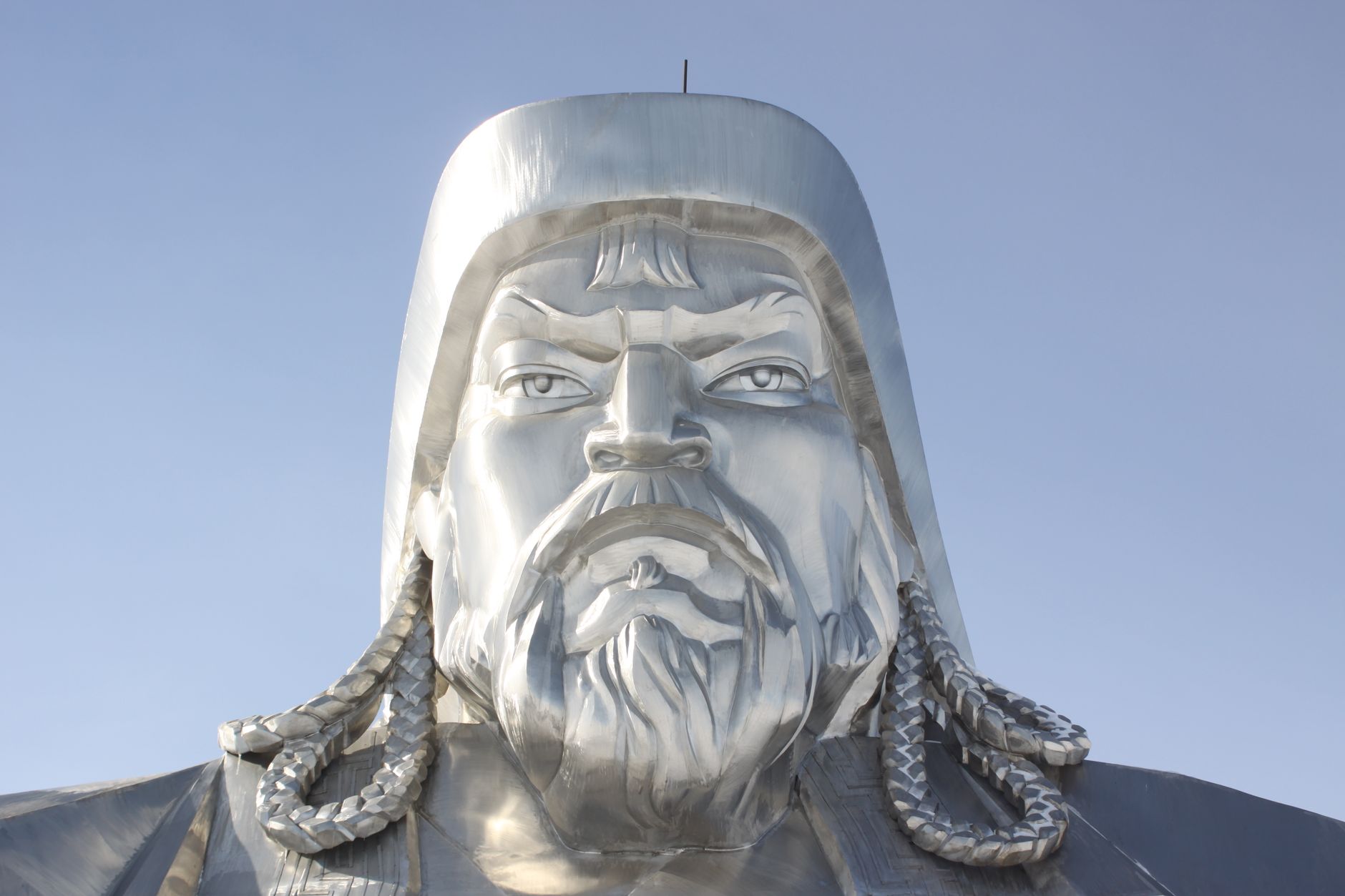
Genghis Khan: The Wildcard Who Shook the Known World
In the 13th century, a nameless, homeless, and seemingly hopeless young man named Temujin emerged from the Mongolian steppes. Within a few decades, he'd be known as Genghis Khan, Emperor of a vast, brutal, and breathtakingly efficient empire that stretched from China to Eastern Europe. What I find remarkable is that Temujin's name still evokes awe and terror today, nearly eight centuries after his death.
(For the record, we don't actually know a lot about Genghis Khan's childhood. Historical records get sketchy during this period, but what we do know is...well, let's get to it.)
The Setup: Genghis Khan's Early Years
Born around 1162 CE, Temujin grew up in the harsh world of the Mongolian steppes. His father, a Mongol chieftain named Yesugei, was a minor player in the regional power struggle. After Yesugei's death, Temujin's family was abandoned by their tribe, forced to eke out a meager existence on their own. This was the defining experience of Genghis Khan's life: being cast aside, struggling to survive, and determined to rise above.
Here's the thing most people miss: Genghis Khan wasn't 'born to be a conqueror.' He was an orphan, a fugitive, and a nobody who somehow, against all odds, managed to turn his circumstances into a superpower. Think about it this way: what if your worst day was actually your best opportunity?
You might assume Genghis Khan was some kind of wild-eyed madman, driven by bloodlust and a desire for world domination. But the truth is more complex. He was a ruthless pragmatist who knew how to get what he wanted – often using tactics that would be considered 'dirty' by today's standards.
The Rise of Genghis Khan: Early Campaigns and Strategic Genius
Genghis Khan's first major victories came from uniting scattered Mongol tribes under his leadership. In 1206, he adopted the title 'Genghis Khan,' or 'Universal Ruler,' which marked the beginning of his remarkable ascent. You see, Genghis Khan wasn't just a warlord – he was a master strategist who leveraged his military prowess, tribal alliances, and brutal suppression of dissent to conquer an unprecedented portion of the known world.
In this period, Genghis Khan's genius was on full display. He implemented a system of merit-based recruitment, which encouraged loyalty, bravery, and strategic thinking among his followers. This may sound exactly like something you'd see on Twitter today – 'Followers first, followers forever!' – but it was actually a revolutionary approach to leadership.
One particularly surprising fact about Genghis Khan's campaigns is the way he used his intelligence network to gather information on enemy armies. He'd have spies infiltrate the enemy's ranks, sending back crucial intel on troop movements, numbers, and weaknesses. This was espionage 101, and it allowed Genghis Khan to stay one step ahead of his foes.
(Now, I'm not saying Genghis Khan was a great human being – quite the opposite. He was responsible for countless atrocities, massacres, and executions. But there's no denying his cunning, strategic brilliance, and unwavering dedication to his cause.)
Why Genghis Khan's Rise Didn't Stop (Spoiler Alert: He Died)
You might think that conquering an empire would lead to a triumphant, victorious ending for Genghis Khan. But in fact, his most famous battles were just the beginning. From the Mongol invasions of Eastern Europe to their conquest of China, Genghis Khan's successors continued to expand the empire with unrelenting ferocity. By 1227, at the peak of his power, Genghis Khan had united a vast territory under Mongol rule.
Here's the wait, really? part: Genghis Khan wasn't the ultimate power-grabber many people assume. He had a remarkably effective system of governance, where meritocracy and tribal loyalty were paramount. It's an interesting thought experiment: what if Genghis Khan had been less 'great' – would the Mongol Empire been less powerful? Less influential? Less terrifying?
But, alas, we will never know, as Genghis Khan died on a campaign in China in 1227, reportedly due to injuries sustained during battle.
Quick Facts:
- Genghis Khan's army was the world's first 'modern' military, with its own logistics, recruitment systems, and (ahem) intelligence operations.
- The Mongols conquered an estimated 35 million square miles of territory, nearly a quarter of the known world at the time.
- By 1241, Genghis Khan's successors had conquered Poland, Hungary, and Bulgaria.
- Genghis Khan was known for his innovative use of cavalry, who rode horses that wore armor and fought on horseback – essentially, the precursor to the armored knights of the medieval era.
- The Mongols had a sophisticated postal system, allowing messages to travel at an astonishing 100 miles per hour across the vast expanse of their empire.
The Human Cost: A Few Notable Names
Genghis Khan's campaign of conquest left a trail of blood and destruction in its wake. One of the most compelling examples of human cost can be seen in the story of the Polish nobleman, Konrad of Masovia.
A brave and resourceful prince, Konrad was one of the few leaders who stood in the way of the Mongol hordes. He fought valiantly, but ultimately, he was forced to surrender his land and his people to Genghis Khan's mercy. The result was heartbreaking: Konrad's kingdom was devastated, his people enslaved, and his city was reduced to rubble.
This, my friends, is the darker side of the Genghis Khan story. But, unfortunately, it's not the only example.
Why Genghis Khan Still Echoes Today: A Modern Parallel
When we talk about Genghis Khan, it's tempting to dismiss his empire-building exploits as quaint relics of the past. But consider this: the Mongol Empire's administrative systems, military strategies, and even their use of propaganda have direct modern parallels. Think, for example, about the current use of drones, cyber warfare, and digital espionage – is this all that different from the Mongol's use of spies and horse-archers?
In fact, the Mongol Empire's legacy can be seen in many modern nations, from Russia to China, where the echoes of Genghis Khan's conquests still reverberate. **Genghis Khan's most lasting legacy might be not his empire-building prowess, but his adaptability, strategic thinking, and sheer cunning – not qualities we often associate with history's most famous (or infamous) leaders.
