Introduction
For centuries, the ancient Egyptians meticulously recorded their history on stone walls and papyrus scrolls. Yet, one of their most successful rulers was nearly scrubbed from existence. Her image was chiseled away, her cartouches obliterated, and her monuments buried under rubble. This is the story of Hatshepsut: the female pharaoh history tried to erase. In this article, we will uncover who she was, how she secured power in a man’s world, and why her stepson launched a campaign against her memory.
Background: The Daughter of Kings
Hatshepsut was not an outsider who seized the throne; she was royalty through and through. Born circa 1507 BCE, she was the daughter of Pharaoh Thutmose I and his principal wife, Queen Ahmose. This lineage gave her an impeccable bloodline, which was crucial in a society where royal divinity determined legitimacy. Unlike many other ancient cultures, Egyptians did not have a specific law forbidding women from ruling, though it was exceedingly rare.
In a standard political maneuver, Hatshepsut married her half-brother, Thutmose II. This union ensured the purity of the bloodline. Thutmose II was the son of Thutmose I and a secondary wife, making his claim to the throne slightly weaker than his sister-wife's. Their marriage produced one daughter, Neferure, but the heir they needed was a son named Thutmose III, born to a harem girl named Iset. When Thutmose II died unexpectedly around 1479 BCE, the dynamics of the empire shifted violently.
Key Events: From Regent to Pharaoh
Upon the death of her husband, Hatshepsut faced a crisis. The heir apparent, Thutmose III, was still a child—likely only two years old. In ancient Egypt, a king who could not command the army or perform rituals was a weakness the empire could not afford. Hatshepsut stepped in as regent, a role intended to be temporary. However, within a few years, she did the unthinkable. She transformed herself from "King's Wife" into "King of Upper and Lower Egypt."
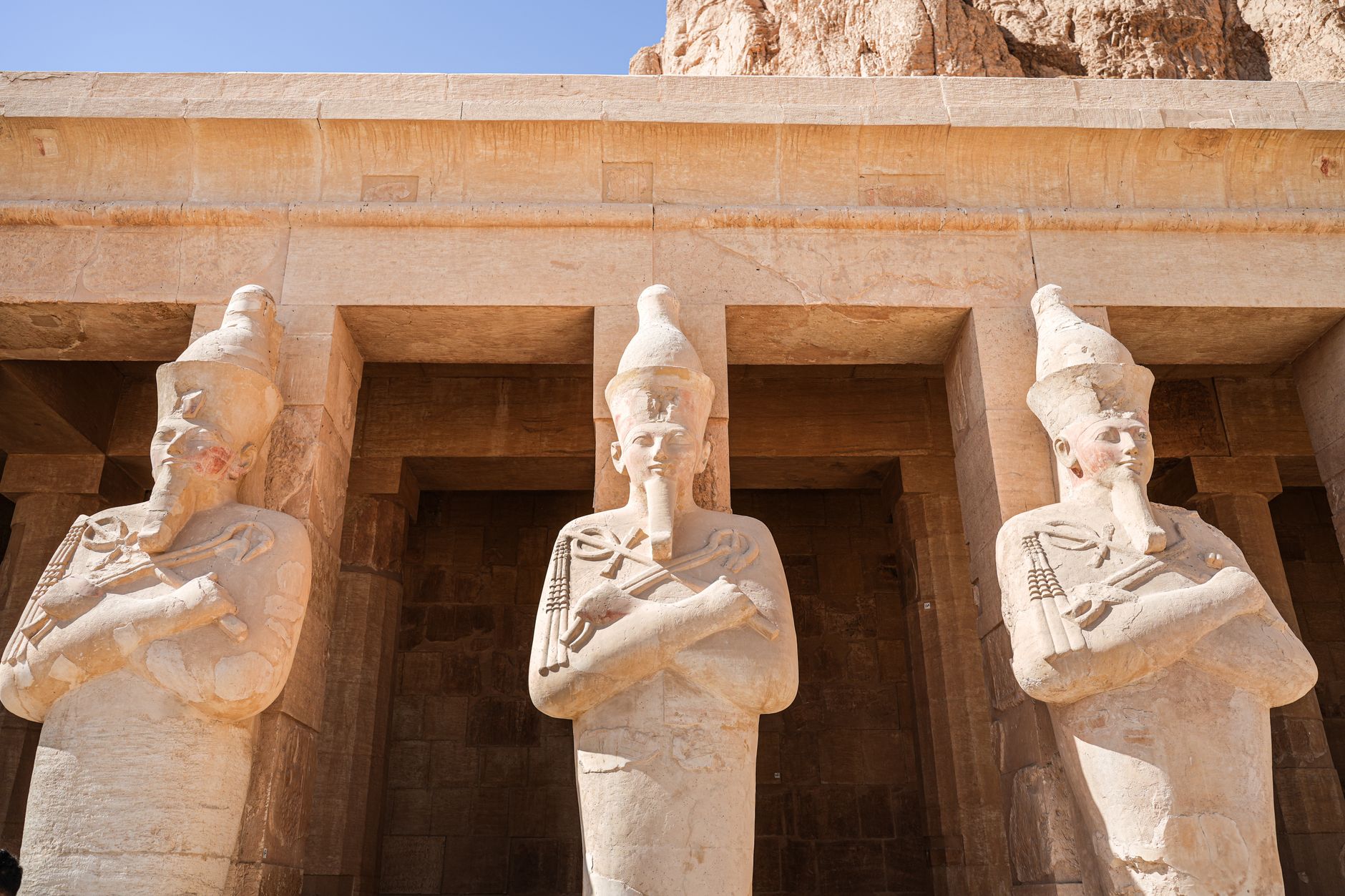
This transition was not a violent coup but a masterclass in ancient propaganda. Around 1473 BCE, Hatshepsut began adopting the full titulary of a pharaoh. She ordered artists to depict her wearing the traditional false beard, the kilt, and the crown of Upper and Lower Egypt. Crucially, she utilized the "Divine Birth" narrative at her mortuary temple, Deir el-Bahri. The reliefs there claimed that the god Amun himself was her true father, appearing to her mother in the form of Thutmose I to conceive her. By claiming direct divine intervention, she circumvented the need for male justification and ruled for over twenty years.
Surprising Facts Most People Don't Know
While most people know Hatshepsut as a female king, there are nuances to her reign that history books often gloss over. First, she was not a warmonger. Unlike her father or the later Ramesses II, Hatshepsut’s reign was characterized by peace. She focused her energy on trade and infrastructure rather than military conquest. Her most famous expedition was to the Land of Punt (likely modern-day Eritrea or Somalia), which brought immense wealth back to Egypt in the form of gold, ebony, ivory, and live myrrh trees.
Another surprising fact is the durability of the myth that she was a usurper. For a long time, historians characterized her as a scheming stepmother who stole the throne from a young boy. Modern Egyptology suggests a different reality: Thutmose III was likely too young to rule effectively, and Hatshepsut’s stewardship arguably saved the empire from fragmentation during his minority. Furthermore, she wasn't the only woman to hold the title of Pharaoh, but she was the most successful, ruling longer than any other woman in Egyptian history.
Impact and Legacy: The Erasure
The irony of Hatshepsut’s life is that her success may have led to her erasure. Twenty years after she died, Thutmose III—now a powerful, adult emperor—began a systematic campaign to destroy her legacy. Her statues were smashed, her images at Deir el-Bahri were chiseled off the walls, and her obelisks were walled up.
Historians initially believed this was an act of vengeance by a resentful stepson. However, current theories suggest a more pragmatic political motive. By the time Thutmose III came into his full power, he had a son of his own to whom he wished to pass the throne. A long line of female predecessors (starting with Hatshepsut) set a dangerous precedent for future males in the lineage. To restore the traditional male line of succession and ensure his own son's legitimacy, Thutmose III likely attempted to delete Hatshepsut from the cycle of history rather than erase her out of personal hatred.
Why This Still Matters Today
Hatshepsut story resonates deeply in modern discussions about gender and power. She navigated a patriarchal system not by dismantling it, but by mastering it. She proved in the 15th century BCE that a woman could lead a superpower to unprecedented economic prosperity and peace. Her erasure serves as a stark reminder of how fragile historical memory is and how those who write history (or carve the stone) often dictate who is remembered. The rediscovery of her mummy in 2007, identified by a tooth found in a box bearing her name, serves as a metaphorical victory, bringing her back into the light after centuries of darkness.
Quick Facts
- Reign Duration: Hatshepsut ruled for approximately 21 years, from circa 1479 to 1458 BCE.
- Architectural Masterpiece: She commissioned the Mortuary Temple at Deir el-Bahri, considered one of the finest architectural achievements in ancient Egypt.
- The Successor: Her stepson, Thutmose III, later became one of Egypt’s greatest warrior pharaohs and expanded the empire significantly.
- Innovation: She reintroduced the trade expedition to Punt, which had not occurred in centuries, boosting the economy.
- Burial Place: She was initially interred in KV20 in the Valley of the Kings, but her mummy was later moved to the tomb of her nurse, KV60, for protection.
- Divine Claim: She is one of the few pharaohs to explicitly claim to be the literal daughter of a god (Amun) in temple carvings.
Conclusion
Hatshepsut was a visionary leader who transformed Egypt from a fragile regency into a powerhouse of trade and architecture. While her stepson attempted to wipe her name from the pages of history, the sheer magnitude of her building projects made that erasure impossible. Today, she stands as a testament to the resilience of women in power and the enduring complexity of the past. How different might our understanding of ancient history be if more women like Hatshepsut had been allowed to remain in the record?