Introduction
Everyone knows the image: a muscular warrior standing victorious in a sun-drenched arena, the roar of the crowd washing over him. Hollywood has painted the life of a Roman gladiator as one of glory, freedom, and ultimate machismo. But the pop-culture version is a polished lie. The brutal reality of being a Roman Gladiator was a short, grim existence defined by blood, commodification, and a complete loss of personal agency. In this article, we will strip away the myth to look at the gritty history of the arena, from the origins of the games to the daily grind of the training schools.
The Origins of the Arena
The story of the gladiator does not begin with entertainment, but with death. The earliest recorded gladiatorial combat in Rome took place in 264 BC. It was not a sporting event; it was a funeral rite. Decimus Junius Brutus Scaeva honored his deceased father by matching three pairs of slaves against one another in the Forum Boarium. This act, known as a munus, was intended to be a blood sacrifice to appease the spirits of the dead.
Over the next two centuries, these private rituals transformed into a massive public spectacle. By the time of the Roman Empire, the munera had lost much of its religious significance and became a tool for political gain. Politicians and Emperors realized that the best way to win the favor of the Roman populace was through "bread and circuses." The games became a display of wealth and power. In 73 BC, the Republic was rattled when a band of gladiators, led by the Thracian fighter Spartacus, broke out of a training school in Capua. This revolt, which turned into a full-scale slave war known as the Third Servile War, highlighted just how volatile and desperate the gladiator population truly was.
The Life of a Combatant
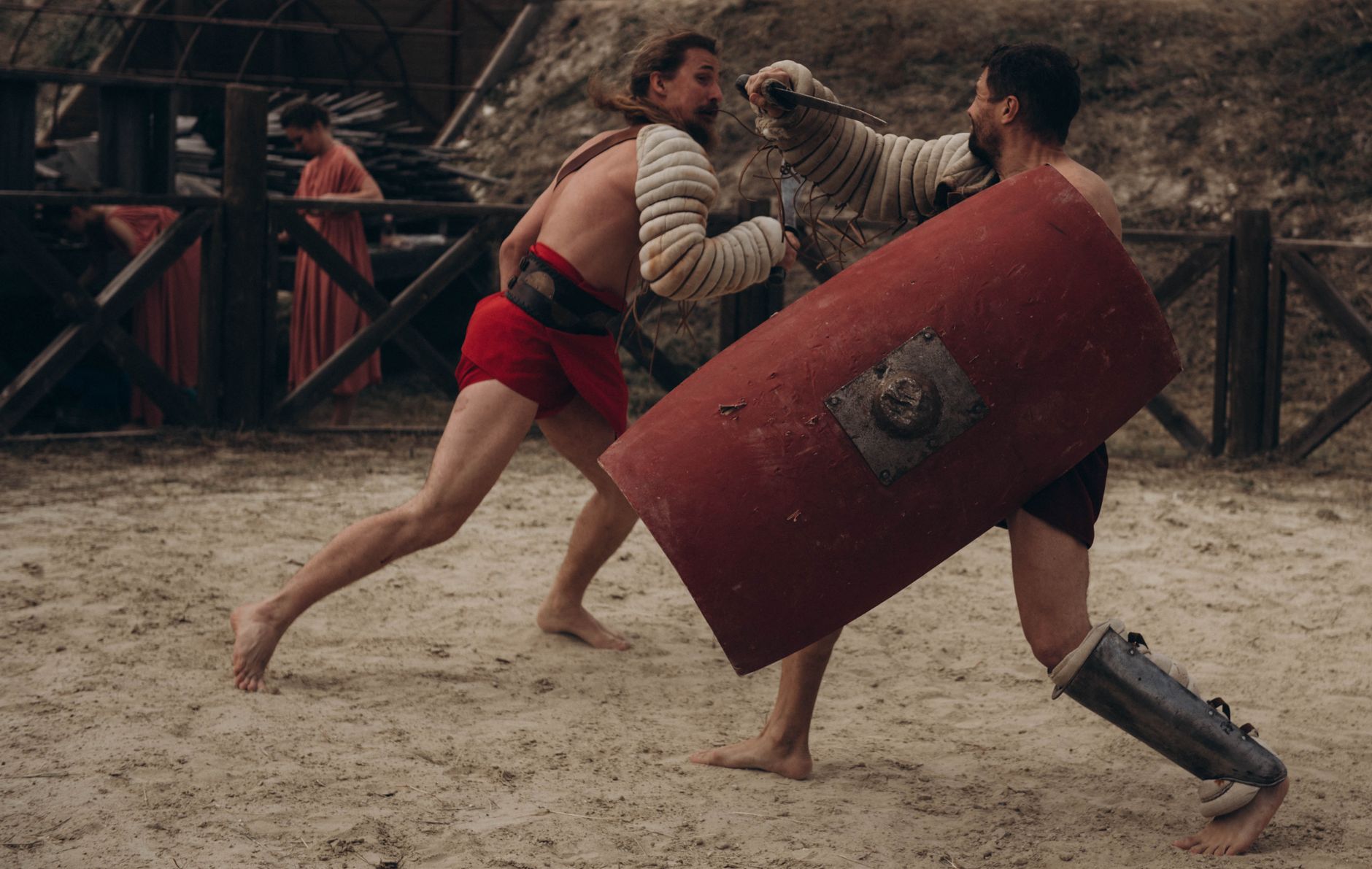
Life for a gladiator began in the ludi, the training schools run by a manager called a lanista. These schools were notoriously harsh, often functioning as prisons. New recruits, known as novicii, were stripped of their freedom and branded with hot irons to mark their status. They were trained in specific fighting styles dictated by their equipment. A secutor chased a retiarius (net-fighter), while a Thraex used a curved short sword and a small shield. These match-ups were designed for theatrical asymmetry, not random brawling.
The reality of the arena was psychologically devastating. Before a fight, gladiators marched into the ring and faced the Emperor’s box. They recited the ominous phrase: "Ave, Caesar, morituri te salutant" ("Hail, Caesar, we who are about to die salute"). Contrary to modern belief, most fights were not meant to be immediate death matches. A gladiator was a valuable financial investment, costing the equivalent of millions of dollars today. A lanista wanted his fighters to survive and fight again. Matches were refereed by officials who could stop the fight to allow a rest. However, if the crowd demanded death and the sponsor gave the thumbs down (pollice verso), the defeated fighter had no choice but to offer his neck for the fatal blow.
Surprising Facts Most People Don't Know
It may shock modern readers to learn that gladiators were primarily vegetarians. Anthropological analysis of bones from a gladiator cemetery in Ephesus revealed a diet heavy in barley and beans, with very little meat. This high-carbohydrate diet created a layer of fat over their muscles, protecting them from shallow cuts and making them look more imposing.
Another myth is the constant bloodshed. Historical records suggest that roughly 90% of fights did not end in death. There were strict rules and referees (summa rudis) to prevent senseless slaughter. Furthermore, not all gladiators were slaves or prisoners of war. Some free men (auctorati) voluntarily signed up to fight. They did this for the glory, the potential prize money, and the fame that came with being a sex symbol in Roman society. Finally, women also fought. Emperor Domitian loved to host night-time spectacles featuring female gladiators (gladiatrices) and dwarves battling by torchlight, a fact often omitted from traditional histories.
Impact and Legacy
The gladiatorial games left an indelible mark on Roman culture, serving as a constant reminder of the Empire's power and the cheapness of life within its borders. The games reinforced a stratified social hierarchy where the death of a lowly slave provided amusement for the elite. This desensitization to violence is often cited by historians as a contributing factor to the moral decay of the Empire. The games were finally banned in 404 AD by Emperor Honorius, primarily due to the rise of Christianity and the martyrdom of a monk named Telemachus, who stoned the crowd for their bloodlust.
The legacy of the gladiator persists today in our modern obsession with combat sports and violent entertainment. However, the Roman games were distinct because they were state-sanctioned executions disguised as sport. They served a dark political utility: they distracted the populace from the corruption and tyranny of their rulers. The Colosseum stands today not just as an architectural marvel, but as a grim monument to a civilization that viewed human life as the ultimate currency.
Why This Still Matters Today
The brutal reality of being a Roman gladiator mirrors uncomfortable truths about our own society. We still live in a culture obsessed with voyeuristic violence, where the suffering of others is often commodified for entertainment. The Roman concept of "panem et circenses"—keeping the people docile with food and spectacle—remains a relevant critique of modern media. Furthermore, the story of the gladiator is a testament to the resilience of the human spirit in the face of dehumanization. Understanding their history prevents us from romanticizing a system built on oppression and helps us recognize similar systems of powerlessness in the modern world.
Quick Facts
- The first gladiatorial games in Rome were held in 264 BC as part of a funeral ritual.
- The Colosseum, known as the Flavian Amphitheatre, could hold between 50,000 to 80,000 spectators.
- Gladiators drank a drink made from plant ashes to fortify their bones after training injuries.
- Roughly one in five gladiators died in the arena during the first century AD.
- The Rudis was a wooden sword given to gladiators to grant them freedom from fighting.
- Emperor Commodus, a fanatical gladiator enthusiast, fought in the arena over 700 times, though never in mortal danger.
Conclusion
The true history of the Roman gladiator is far more gritty and complex than the movies would have you believe. These men were not just warriors; they were commodities, prisoners, and desperate souls trapped in a machine of violence. While we admire their strength and skill, we must never forget the brutal system that owned them. If you could step back in time to watch a game at the Colosseum, would you cheer, or would you look away?