Introduction
Imagine standing in a narrow pass, flanked by sheer cliffs and the crashing sea. Behind you lie the cities of your families and the birthplace of democracy. Ahead, an army so vast its arrows allegedly blotted out the sun. This is the image etched into Western history: The Battle of Thermopylae. While Hollywood has immortalized the muscle and grit of the Spartans, the full history of Thermopylae involves complex strategy, political alliances, and a last stand that saved Western civilization. In this article, we will explore the facts about the Battle of Thermopylae, separating myth from reality to explain how 300 Spartans and a few thousand allies took on the might of Persia.
Background and Origins
The seeds of this legendary conflict were sown years before Leonidas set foot in the pass. In 490 BC, the Persian Empire, under King Darius I, attempted to invade Greece but was repelled at the Battle of Marathon. This defeat embarrassed the Persian Empire and left a thirst for revenge in the successor, Xerxes I. By 480 BC, Xerxes had spent years amassing a force the ancient world had never seen. Herodotus, the Greek historian, claimed the Persian army numbered over two million, though modern historians estimate a still-staggering 100,000 to 300,000 soldiers.
Xerxes did not rely on raw numbers alone. He oversaw an engineering marvel, constructing a pontoon bridge across the Hellespont (the Dardanelles strait) to march his army from Asia into Europe. As this massive force marched south toward the Greek heartland, the Greek city-states faced an existential crisis. Many northern states, seeing the sheer size of the invasion, "medized"—they surrendered and allied with Persia to save their own skins. However, a coalition of southern Greek states, led by Sparta and Athens, decided to resist.
The strategy was formed at the Corinthian Congress. Athens, a naval power, took to the sea, while Sparta, a land power, supplied the hoplites. They needed a location to neutralize the Persian advantage in numbers. They chose Thermopylae, the "Hot Gates," a narrow coastal pass in central Greece. At the time, the pass was barely wide enough for a few wagons to pass abreast, funneling the Persian army into a choke point where their numbers would become a liability rather than a strength.
Key Events and The Core Story
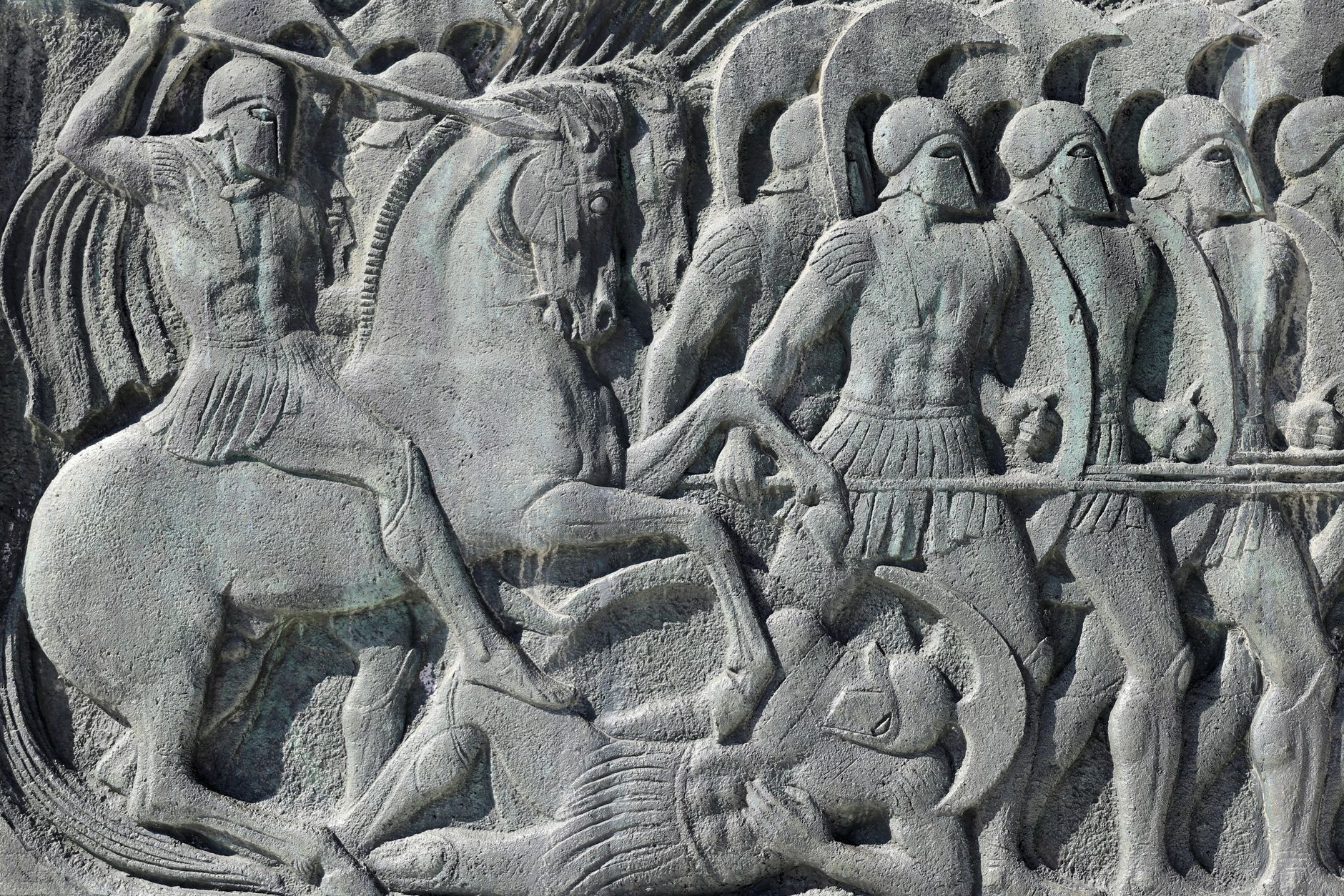
King Leonidas I led the initial Greek force to the pass. He arrived with roughly 7,000 men, including his famous 300 Spartans, but also thousands of Mantineans, Tegeans, Arcadians, Corinthians, Thespians, and Thebans. For the first two days of battle, the strategy worked perfectly. The Persian Immortals, the elite shock troops of Xerxes, were unable to break the Greek phalanx formation. The heavily armored Greek hoplites used their long spears and large shields to drive back the lighter Persian infantry time and again. The narrow pass prevented the Persians from utilizing their superior flanking maneuvers, turning the battle into a brutal grinding match where the Greeks held the distinct advantage.
The tide turned on the third day due to betrayal. A local resident named Ephialtes informed Xerxes of a goat path known as the Anopaia track that wound through the mountains and allowed the Persians to bypass the main Greek defensive wall. Upon receiving this intelligence, Xerxes immediately dispatched his Immortals under Hydarnes to flank the Greeks. When Leonidas learned that the Persians were scaling the mountains behind them, he held a council of war. Realizing the position was lost, he ordered the bulk of the Greek army to retreat and regroup. However, staying behind was a matter of Spartan law and honor.
Leonidas dismissed the other contingents, but they refused to leave. The Thespians, led by Demophilus, insisted on staying to the death, as did 700 Thespians and 400 Thebans. The final morning saw the last stand. Instead of fighting defensively from the wall, the remaining Greeks marched out into the wider part of the pass to kill as many Persians as possible. They fought with spears until they broke, then switched to swords. Eventually, the Spartans were forced to a small hillock. There, surrounded and out of ammunition, they fought with their hands and teeth. The Persians, unable to subdue them in hand-to-hand combat, resorted to raining down arrows until every defender was dead. Leonidas fell, and a furious struggle ensued over his body, which the Greeks successfully recovered four times.
Surprising Facts Most People Don't Know
The most pervasive myth about Thermopylae is that only 300 Spartans fought there. In reality, the Spartans were an elite royal guard unit within a much larger force of roughly 7,000 Greeks. The 300 Spartans were chosen not just for their skill, but because they all had living sons, ensuring their family lines would not be extinguished. Furthermore, the "300" narrative completely ignores the 700 Thespians. The Thespians were not forced to stay; unlike the Spartans, who had a religious decree forbidding retreat in certain situations, the Thespians were volunteers. They refused the order to retreat and fought to the death alongside the Spartans, suffering near-total casualties.
Another surprising fact involves the geography itself. If you visit Thermopylae today, it looks nothing like the battlefield of 480 BC. The coastline has receded significantly due to silt deposits over the last 2,500 years. The "cliffs" are now miles from the sea, and the pass is a broad, flat plain. The Spartans were not fighting the Persian army in an open field; they were fighting them in a confined space that negated the Persian advantage. Finally, the battle was not a standalone tactical victory; it was a holding action simultaneous with the naval Battle of Artemisium. The land army bought time for the Greek navy to hold their position, proving the operation was a coordinated strategic defense rather than a singular act of suicide.
Impact and Legacy
While the Battle of Thermopylae was a military defeat for the Greeks resulting in the sack of Athens (which was evacuated), it was a monumental strategic and moral victory. The sacrifice of Leonidas and his men delayed the Persian advance, giving the Athenian navy time to prepare. This preparation directly led to the Greek victory at the Battle of Salamis, a naval engagement that destroyed the Persian fleet. Without the time won at Thermopylae, the Greek alliance might have fractured before Salamis could even be fought.
Psychologically, Thermopylae changed the course of the war. It shattered the myth of Persian invincibility. If two days of fighting by a small force could decimate the Imperial troops, then the Persian Empire was not the unstoppable monster the Greek city-states feared it to be. This morale boost was crucial for the subsequent battles at Plataea and Mycale, where the Greeks finally expelled the Persians. The battle became a symbol of self-sacrifice for the greater good, a concept deeply embedded in Western military ethos. It allowed the Greeks to preserve their developing systems of democracy, philosophy, and political thought, which would later become the foundation of Western civilization.
Why This Still Matters Today
The story of Thermopylae resonates deeply in modern American culture and global politics, often appearing as a metaphor for standing against insurmountable odds. In the US military, the concept of a "last stand" is viewed through the lens of Thermopylae—fighting not because you will win, but because holding the line allows others to succeed or survive. The phrase "Molon Labe" (Come and take them), allegedly spoken by Leonidas when the Persians demanded the Greeks lay down their weapons, is a ubiquitous slogan in the Second Amendment community and libertarian circles, symbolizing defiance against tyranny.
Furthermore, the battle is a staple of pop culture, most notably in the film 300 and comic literature. While these adaptations often prioritize entertainment over historical accuracy, they sustain the fascination with Sparta's warrior culture. The battle serves as a reminder that numbers and resources are not the only determinants of history. Strategy, terrain, and sheer willpower can shift the balance of power. In an age of technological warfare, the lessons of Thermopylae regarding asymmetrical warfare and the importance of high morale remain relevant to military strategists and leaders today.
Quick Facts
- The battle occurred in August or September of 480 BC.
- The Greek forces likely numbered around 7,000 men on the first day, not just 300.
- The Persian fleet was simultaneously defeated in storms off the coast of Magnesia before the land battle began.
- The Theban contingent was allegedly held as hostages against their will by Leonidas, who suspected they might medize.
- A carved stone lion was erected at Thermopylae to commemorate Leonidas, whose body was beheaded and crucified by Xerxes.
- The pass was called "Hot Gates" because of the sulfur springs located there.
Conclusion
The Battle of Thermopylae was not a victory in the traditional sense, but it was a pivotal moment where courage altered the trajectory of history. By holding the pass, the Greeks bought the time necessary for their civilization to survive and flourish. We remember it today not for the death toll, but for the refusal to yield in the face of annihilation. Considering the vast difference in numbers between the two armies, could the Spartans have achieved anything without their specific choice of terrain?